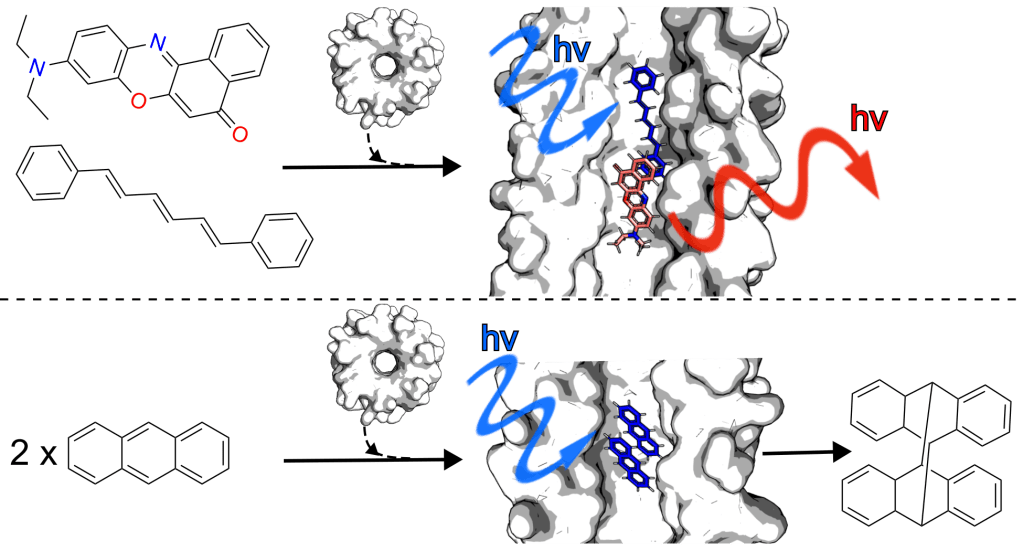
Peptide barrel paper accepted in JACS

Congratulations to Rokas on the acceptance of his paper, Confinement and Catalysis Within De Novo Designed Peptide Barrels, in the Journal of the American Chemical Society. The work was part of a joint study with Dek Woolfson.

The paper showcases the potential of α-helical barrel (αHB) peptide assemblies as versatile molecular tools to act as “molecular flasks.” The αHBs can selectively bind small molecule fluorophores such as Diphenylhexatriene or Nile Red within the hydrophobic lumen in specific orientations in close proximity to facilitate very rapid and efficient FRET. Additionally, the same barrels bind two anthracene molecules and catalyse photodimerisation reactions, underscoring their potential in complex chemical reactions.

Notably, the work illustrates the importance of protein design, as not all ternary complexes were productive at FRET or photocataylsis.

The article is available to read here, and has been highlighted by an article in the American Peptide Society.

Nile Red paper accepted

Congratulations to Camilla for having her 1st first author accepted for publication in the Journal of Physical Chemistry B on the photophysics of bioimaging dye Nile Red. The origin of Nile Red’s fluorescence has been disputed for decades, with some studies claiming that the dye fluoresces from two excited states, and/or the main emissive state is twisted and intramolecular charge-transfer (ICT) in character, as opposed to planar ICT (PICT). Using an arsenal of experimental and theoretical methods, we definitively prove that molecule’s fluorescence originates from a PICT state. The article is available to read here.

Congratulations Hilary!

Well done to Hilary McCarthy who passed her PhD viva voce exam yesterday afternoon. Hilary was jointly supervised by Heather Whitney, Carmen Galan and Tom. Her thesis focused on the effect of carbon nanodots on the photosynthesis of micro algae, and photonic effects in chloroplasts of shade plants. Her PhD was his highly multidisciplinary, coupling ultrafast fluorescence spectroscopy, microscopy, synthetic chemistry and biology!

Since submitting her thesis, Hilary has been part of innovate UK’s ICURe programme, which she has just recently secured follow on funding for.

Leverhulme International Fellowship Awarded

Tom has been awarded a Leverhulme International Fellowship. The fellowship will allow Tom to pursue fundamental studies of solvated electrons- a critical species in radiation damage, redox chemical transformations and charge-transfer in biology. He will also pioneer new spectroscopic techniques to unravel the complex and deleterious photoionization reactions of aromatic amino acids and DNA after absorption of ultraviolet light.

As part of the fellowship he will work at University of California, Los Angeles with Prof. Benjamin Schwartz, and at the University of Southern California with Prof. Stephen Bradforth.

Photoionisation of indole in water paper accepted for publication

Tom and Steve Bradforth (University of Southern California and former Bristol Benjamin Meaker Visiting Professor with Tom in 2018), have unravelled the complex photoionisation dynamics of indole, the UVB chromophore of tryptophan, in water using a combination of ultrafast laser experiments and theory. The study has just been accepted for publication in the Journal of Physical Chemistry B and available to read here.

Welcome to Somnath

Welcome to Somnath Kashid who joins us as a postdoctoral research fellow on the BBSRC sLoLa Circuits of Life grant. Somnath obtained his PhD from CSIR-National Chemical Laboratory, Pune, under the supervision of Dr Sayan Bagchi where he used ultrafast two-dimensional infrared spectroscopy and molecular dynamics simulations to study hydrogen bond dynamics. He then conducted postdoctoral research with Prof Arindam Chowdhury at IIT, Bombay using single molecule florescence spectroscopy and FLIM to study Molybdenum disulfide plates.