 The current research of the Oliver group is summarised in this poster. Click on the thumbnail for a link to the full size version.
Bristol Centre for Functional Nanomaterials Extended Project Details
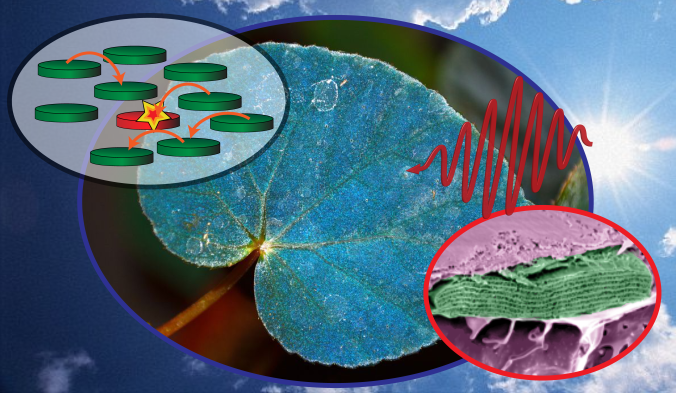
Plant photonic bionics: Combining natural photonic structures with carbon nanoparticles to enhance photosynthesis
The project is jointly supervised by Dr Heather Whitney (Life Sciences) and Dr Tom Oliver (Chemistry), with associated academics Dr Carmen Galan, Dr Henkjan Gersen and Dr Ruth Oulton. For more details contact Heather or Tom
| Project description: | |
| The ability of photosynthetic organisms such as plants and algae to harvest energy sun light through photosynthesis is not only one of the fundamental processes of life on Earth, but can provide inspiration for solar energy capture in artificial light harvesting. Photosynthetic organisms have highly evolved and efficient machineries to capture the incident solar flux. One of the more unexpected mechanisms by which plants interact with light, that may have implications for solar energy transduction, is the presence of structures that lead to plants becoming iridescent– a form of structural colour that changes hue depending on the viewing angle.
The iridescence is produced by materials that are micro-structured on a comparable scale to the wavelength of incident light, and very similar to man-made “photonic crystals”. While iridescence produced by animals such as peacocks and butterflies has been widely studied, iridescence in plants has largely been ignored. Yet, not only do these biological microstructures have properties not seen in “photonic crystals”, but we have also found that they can function to enhance the light harvesting quantum yield in photosynthesis (Jacobs et al., 2016 Nature Plants). Chloroplasts in species of Begonia that grow under extremely low light conditions develop in a unique way and form a photonic crystal. This structure enhances the light harvesting quantum efficiency of the chloroplast – which could be advantageous, as usually only 25% of available light is even initially captured by chlorophyll in the photosynthetic proteins. However, the advantages that iridescence provides appears to come at a significant cost – the operating efficiency, i.e. final yield of sugars and carbohydrates, of these photonic chloroplasts is lower than that of normal chloroplasts under standard light conditions. The underlying reason for the lower yield of carbon fixation is unclear, but we hypothesize is due to enhanced non-photochemical quenching (NPQ) mechanisms in the iridescent chloroplasts. NPQ is a suite of rapidly reversible processes that allow plants to dissipate excess energy and avoid damage arising from over-exposure to sunlight. Evolution has therefore not been able to couple the higher initial light harvesting yields afforded by the photonic crystal like properties of iridescent chloroplasts (the plants that evolved these structures only require the slow photosynthesis of deep shade conditions), with a concomitant increased carbon fixation yield, however, studies in a second area of nanomaterials science (bionics) might provide a solution. Plants that take up fluorescent nanoparticles such as carbon dots have been found to have increased photosynthetic rates, potentially due both the enhanced light capture in regions of the solar spectrum not covered by native chlorophyll and carotenoid pigments and/or enhanced rates of electron transport. Initially this project will use established protocols to quantify the higher quantum efficiency and operating efficiency in photonic chloroplasts that incorporate carbon dots. The molecular structure of these iridescent chloroplasts will be probed using fluorescence lifetime measurements. This latter step will require integration of time-correlated single photon counting detection hardware with a newly established ultrafast laser system. If successful this could lead to both increases in crop and photobioreactor yield, and provide inspiration for the design of bioinspired solar energy capture devices |
|
| Key Objectives: | |
The objectives of this project will be achieved by a multidisciplinary approach, with work taking place in several leading laboratories at the University of Bristol. These include:
|
|
| Relevant publications: | |
| [1] H. Whitney et al., Science 323: 130-133 [2] Giraldo et al., Nature Materials 13: 400-408. [3] M. Jacobs et al., Nat Plants. 2, 16162 (2016). [4] S. A. Hill et al., Nanoscale. 8, 18630–18634 (2016). | |
Welcome to Gary and Venki
We welcome Gary and Venki to the Oliver research group. Gary and Venki will be investigating the excitonic properties of J-aggregate films using transient absorption spectroscopy as part of a Bristol Centre for Nanomaterials theta project. The research is jointly supervised by Dr Sara Núñez-Sánchez in the faculty of Engineering.
Victoria Taylor on BBC Radio Bristol!
 Victoria was interviewed by BBC Radio Bristol for the Laura Rawlings show as part of their ‘Cabinet of Curiosities’ segment curated by the Bristol Centre for Functional Nanomaterials. Victoria gave a splendid overview of her PhD research project that involves investigating the molecular mechanisms of photosynthesis. The interview can be found on BBC iPlayer here and starts at 26:20.
Ashley Beckstead Visiting from Montana State University
 Ashley Beckstead from Montana State University and the laboratory of Professor Bern Kohler, is visiting our group for two weeks to investigate the non-adiabatic relaxation dynamics of violacein molecules in various solutions.
EPSRC Funded Postdoctoral Research Associate Position Available
Applications are invited for an EPSRC funded research associate role with Dr Tom Oliver in the Laser Chemistry, Spectroscopy and Dynamics Group in the School of Chemistry at the University of Bristol. This project involves a close collaboration with Dr Mike Jones in the School of Biochemistry. The appointee will use state-of-the-art multidimensional optical spectroscopies to explore inter-pigment electronic energy transfer dynamics in bacterial reaction centres.
Applicants should have, or be about to graduate with a Ph.D. in Chemistry, Chemical Physics, or a related discipline. Candidates should have proven experience with at least some of the following: laser spectroscopy, ultrafast laser technology and non-linear optics.
This 1 year position is available from 1st January 2017.
The research associate will also be expected to assist in supervising PhD students in the research group of Dr. Tom Oliver. Informal enquiries may be addressed to: tom.oliver@bristol.ac.uk.
The full job description can be found here and applications made here.
Second Grant in Two Weeks Funded!
We heard from the Royal Society today that a small Research Grant (£15K) was successfully funded. This grant will enable us to construct a fully background free 2DES spectrometer.
EPSRC First Grant Funded
 EPSRC informed us that our research grant “Exploring Delocalised Energy Transport in Bacterial Reaction Centres” was successfully funded. The grant provides financial support for a postdoctoral researcher and a consumables budget to construct a 2D electronic-vibrational spectroscopy apparatus. The project includes a close collaboration with Dr Mike Jones in Biochemistry.
Welcome to Marta and Victoria!
This week we welcome Victoria and Marta as incoming PhD students to the Oliver research group. They will be exploring the weird and fascinating dynamics of photosynthetic light harvesting and photovoltaic materials using novel multidimensional optical spectroscopies and ultrafast microscopy.
Ultrafast Oscillator, OPO and Microscope
Henkjan Gersen (Physics, Bristol), Marta Duchi (starting in September in our group) and I trekked back and forth to Norwich this week to collect an Ultrafast Tunable Oscillator (Chameleon, Coherent), OPO (Coherent), Nikon Inverted Microscope and other toys! In total we travelled 500 miles in two days but everything made it to Bristol in one piece.


 The Oliver Research Group