The Oliver group works on a diverse range of photoinduced phenomena ranging from photophysical properties of simple molecular systems to complex photobiological processes in natural and designer proteins. These dynamics rely on strong links with our collaborators and are studied using multiple ultrafast laser experiments.
Ultrafast dynamics of photoactive proteins
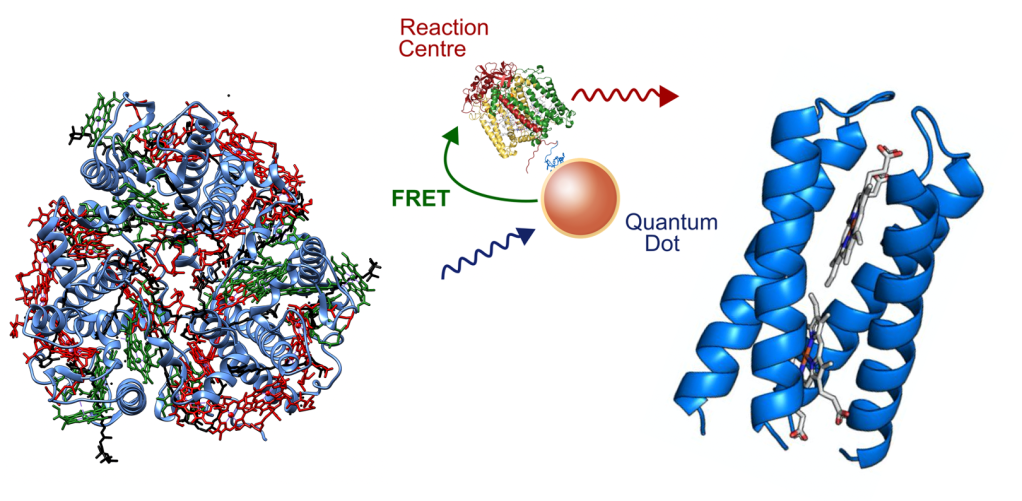
Photosynthetic and photoactive proteins are essential to all life on Earth, playing pivotal roles in the primary steps of light harvesting of plants, to the first event in vision. Our interests include the study of natural photoactive proteins, bio-nanohybrid systems combining photosynthetic proteins with nanomaterials, and specially designed (de novo) proteins. Using an array of time-resolved experiments, we are able to determine the photobiological dynamics including timescales for electron and electronic energy transfer, and the protein’s role in mediating these events.
Coherent nuclear dynamics
With the short pulses available in our laboratories (<8 fs), we are able to drive and monitor a range of different coherent dynamics within molecules, polymers and proteins. These include vibrational wavepacket dynamics present in pump-probe or two-dimensional electronic spectroscopy (2DES) measurements. The coherent wavepacket dynamics allow us to gain insights into how the electronic structure on the excited state evolves, and the nuclear motions that drive coupling of multiple electronic states at conical intersections.

Influence of environment on photochemical reactions
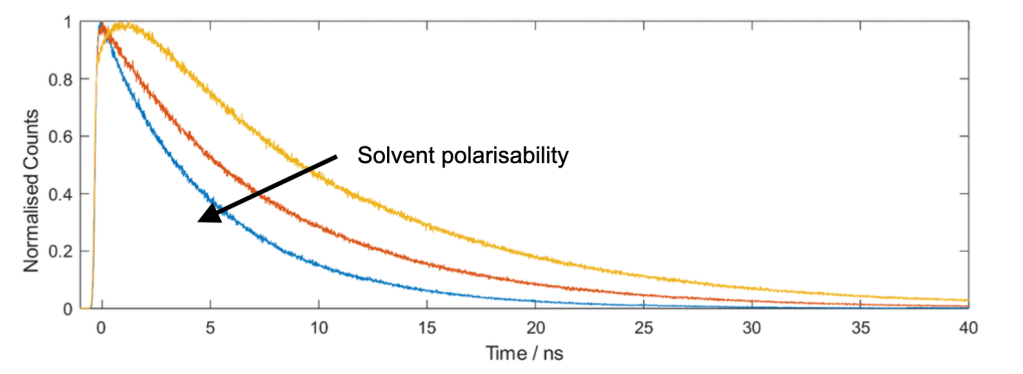
Molecules in solution rotate, collide and inter-change energy with their surroundings on picosecond or shorter timescales. The magnitude and timescale of these interactions alter and determine the excited state photochemical/physical dynamics.
Nanomaterials and their enhancement of photosynthesis
Carbon nanodots (CDs) are non-toxic nanomaterials with appreciable fluorescent quantum yields making them ideal for biosensing. Further, they can be synthesised using a 3-minute microwave assisted synthesis from cheap starting materials. Uptake of specially functionalised CDs by plants and algae can induce increased photosynthetic quantum yields and enhanced biomass production.
Cutting-edge ultrafast laser spectroscopy

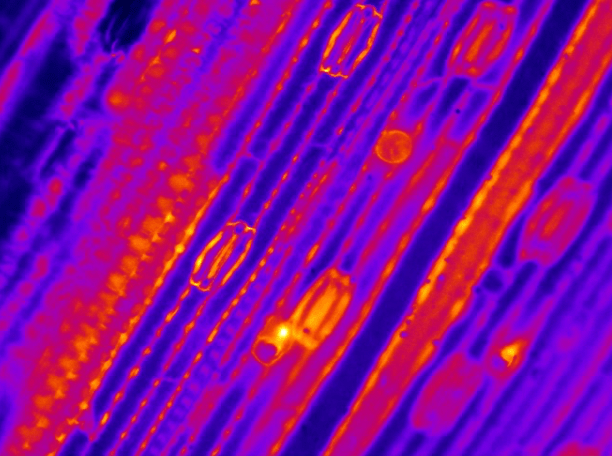
The Oliver laboratory houses multiple world-class experiments capable of studying photoinduced chemical and biomolecular dynamics. These techniques include: a two-dimensional electronic spectroscopy experiment with 8-fs time resolution and a multi-octave laser source (500-750 nm); a synchronised dual amplifier laser system capable of seamlessly tracking dynamics from 100 fs to 1 ms under the same experimental conditions with either transient absorption or time-resolved infrared spectroscopies.
 The Oliver Research Group