M y application for an ultrafast laser system has been successful. In the next two months we will receive a Coherent Libra regenerative amplifier laser system (1W, 100 fs) and OPerA Solo optical parametric amplifier. The laser is being retired due to the closure of the laser loan pool administered by the Central Laser Facility at the Rutherford Appleton Laboratory.
PhD Vacancy
Unravelling Energy and Charge Transport Mechanisms in Natural Light Harvesting and Photovoltaic Materials
A fully funded PhD position is available in the Oliver group with a standard EPSRC stipend of £14,296 for 2016/2017.
Photosynthetic organisms harness energy from sunlight to power most biological activity on Earth. Inside chloroplasts of plants, sunlight is absorbed by billions of chlorophyll molecules and used to drive photosynthesis; carbon dioxide and water are converted into simple sugars essential for plant growth. This remarkable natural process regularly achieves 100% efficiency: every photon absorbed is converted into chemical energy. Our efforts to harness solar energy with man-made photovoltaic (PV) technology to generate electricity have, to date, been far less effective. To meet the ever-growing global energy demands, it is imperative for our society to develop renewable and more efficient PV devices that can take full advantage of the abundant solar flux.
This project will use cutting-edge ultrafast laser spectroscopies such as two-dimensional electronic-vibrational spectroscopy [1] and 2D electronic spectroscopy [2], to follow create a map of energy/charge flow between molecules with femtosecond time resolution (1 fs = one millionth billionth of a second) in natural light harvesting proteins, biomimetic counterparts and leading PV materials such as perovskites, quantum dots and organic bulk heterojunction polymers.
By understanding the routes and timescales of energy flow inside natural light harvesting systems and PV materials, we will seek to gain a fundamental understanding on the molecular level of the mechanisms that underpin energy transport and charge-separation. These insights will provide (1) a greater fundamental understanding of natural light harvesting and (2) a guide to the design of the next-generation thin film PV materials.
This project involves strong collaborations with Dr Mike Jones, Dr Ross Anderson (School of Biochemistry), and Professor David Fermin (School of Chemistry) at the University of Bristol.
[1] TAA Oliver, NHC Lewis and GR Fleming, Proc. Natl. Acad. Sci., 111, 10061 (2014).
[2] VM Huxter, TAA Oliver, D Budker and GR Fleming, Nat. Physics., 9, 744 (2013).
For more project details and informal enquiries contact Dr Tom Oliver: tom.oliverATbristol.ac.uk
Rutherford Appleton Laboratory Laser Time Granted
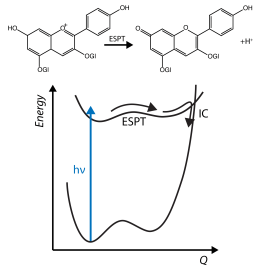 My project to study the ultrafast relaxation pathways of anthocyanins has been granted laser time at the Rutherford Appleton Laboratory.
Higher plants have an extremely sophisticated suite of photoprotective mechanisms that prevent damage in high light conditions. Mechanisms involving anthocyanin molecules have to date received little attention, despite comprising 50% of pigments in leaves during the Autumnal period.
Anthocyanins such as malvin, cyanin and pelargonin are thought to provide a sunscreen to chlorophyll containing proteins, absorbing any excess light in the blue-green part of the solar spectrum, and dissipating this excess energy harmlessly.
Our study will seek to determine whether non-radiative decay of anthocyanin molecules are driven by excited state or ground state proton transfer.
Three Bristol Centre for Functional Nanomaterials Extended Protects
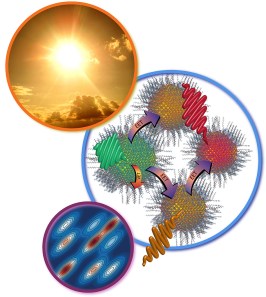 I am involved as supervisor or associated academic on three Bristol Centre for Functional Nanomaterials (BCFN) extended projects. All three projects have the possibility to extend into full PhD projects.
These projects will soon be available on the BCFN portal. The projects include the synthesis, characterisation and ultrafast dynamics of hybrid bio-nanomaterials and quantum dot funnel arrays for light harvesting applications.
If you have any questions about the projects, do not hesitate to contact me at tom.oliverATbristol.ac.uk
Research Culture
At my Royal Society Induction, I had the great pleasure to see a talk by Prof. Ottoline Leyser on the UK research culture. Ottoline discussed the findings from the 2014 Nuffield Research culture report, which is very worthy of a read.
The two findings that caught my interest most were:
“Attempts to assess the societal and/or economic impact of research are welcomed by some, but others believe this is creating a culture of short-termism and is pushing aside interest in curiosity-driven research, as well as resulting in researchers exaggerating the potential application of research in grant proposals”
“The perception that publishing in high impact factor journals is the most important element in assessments for funding, jobs and promotions is creating a strong pressure on scientists to publish in these journals. This is believed to be resulting in important research not being published, disincentives for multidisciplinary research, authorship issues, and a lack of recognition for non-article research outputs. The Research Excellence Framework (REF) is thought to be a key driver of the pressure to publish in high impact journals.”
Theory Paper Makes Most Read 2015 list of the Journal of Chemical Physics
EPSRC NSCCS Molpro Workshop
I was invited to speak at the EPSRC NSCCS Molpro Workshop, illustrating how Molpro can be used to calculate specific molecular properties and understand experimental results. The case studies presented concentrate on phenol and thiophenol in the gas phase using an array of multireference ab initio methods. The slides can be found here.
PhD and Postdoctoral Vacancies
PhD Studentships
A funded 3.5 year PhD studentship is available in my group at the University of Bristol in the School of Chemistry. The PhD project will focus on unravelling the primary photoprotection pathways of DNA. The studentship pays an annual tax-free stipend of £14,057.
To apply for this position, in the first instance, please contact me via email at tom.oliver@bristol.ac.uk. Formal application forms can be found here.
Postdoctoral Positions
I welcome applications from highly motivated postdoctoral researchers to work in my research group. Please contact me for more details of potential projects via email. Funding can be sought from any of the following sources:
Marie Curie Fellowships
Leverhulme Fellowships
Newton International Fellowship
EPSRC Postdoctoral Fellowships
Ramsay Memorial Fellowship
Royal Commission for the Exhibition of 1851
Chemical Synthesis CDT Brainstorming Session
I was fortunate to co-chair a brainstorming session with Dr. Carmen Galan, in the Bristol Chemical Synthesis Centre for Doctoral Training last Friday. The aim of the project is to synthesise specific DNA duplexes and hairpin structures, with functional linker groups, to investigate the initial stages of UV photo-protection using cutting edge ultrafast spectroscopies. The presentation can be found here.
2DEV Theory paper highlighted in J. Chem. Phys.
The Journal of Chemical Physics has highlighted our recent theory paper that demonstrated how 2D electronic-vibrational spectroscopy can connect directly the site and excitonic bases of molecular aggregates. The paper is available to download and read for free.
 The Oliver Research Group