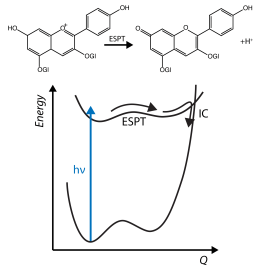
 My project to study the ultrafast relaxation pathways of anthocyanins has been granted laser time at the Rutherford Appleton Laboratory.
Higher plants have an extremely sophisticated suite of photoprotective mechanisms that prevent damage in high light conditions. Mechanisms involving anthocyanin molecules have to date received little attention, despite comprising 50% of pigments in leaves during the Autumnal period.
Anthocyanins such as malvin, cyanin and pelargonin are thought to provide a sunscreen to chlorophyll containing proteins, absorbing any excess light in the blue-green part of the solar spectrum, and dissipating this excess energy harmlessly.
Our study will seek to determine whether non-radiative decay of anthocyanin molecules are driven by excited state or ground state proton transfer.
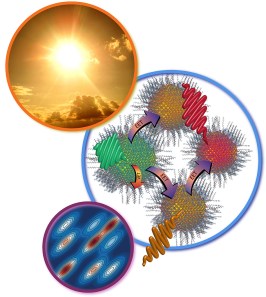 I am involved as supervisor or associated academic on three
 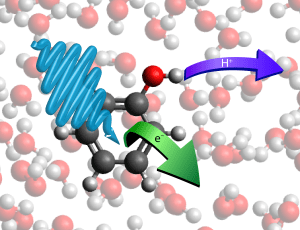 My paper “Exploring Autoionization and Photo-Induced Proton-Coupled Electron Transfer Pathways of Phenol in Aqueous Solution” has been accepted for publication in
  Our theory paper that derives the electronic-vibrational response functions to model energy transfer in a molecular dimer, and proposes a method to extract both excitonic and site populations from 2D electronic-vibrational spectra has been published in the Journal of Chemical Physics. The paper can be read online for free,
